Higher Diploma
Electrical & Electronic Engineering
Liverpool John Moores University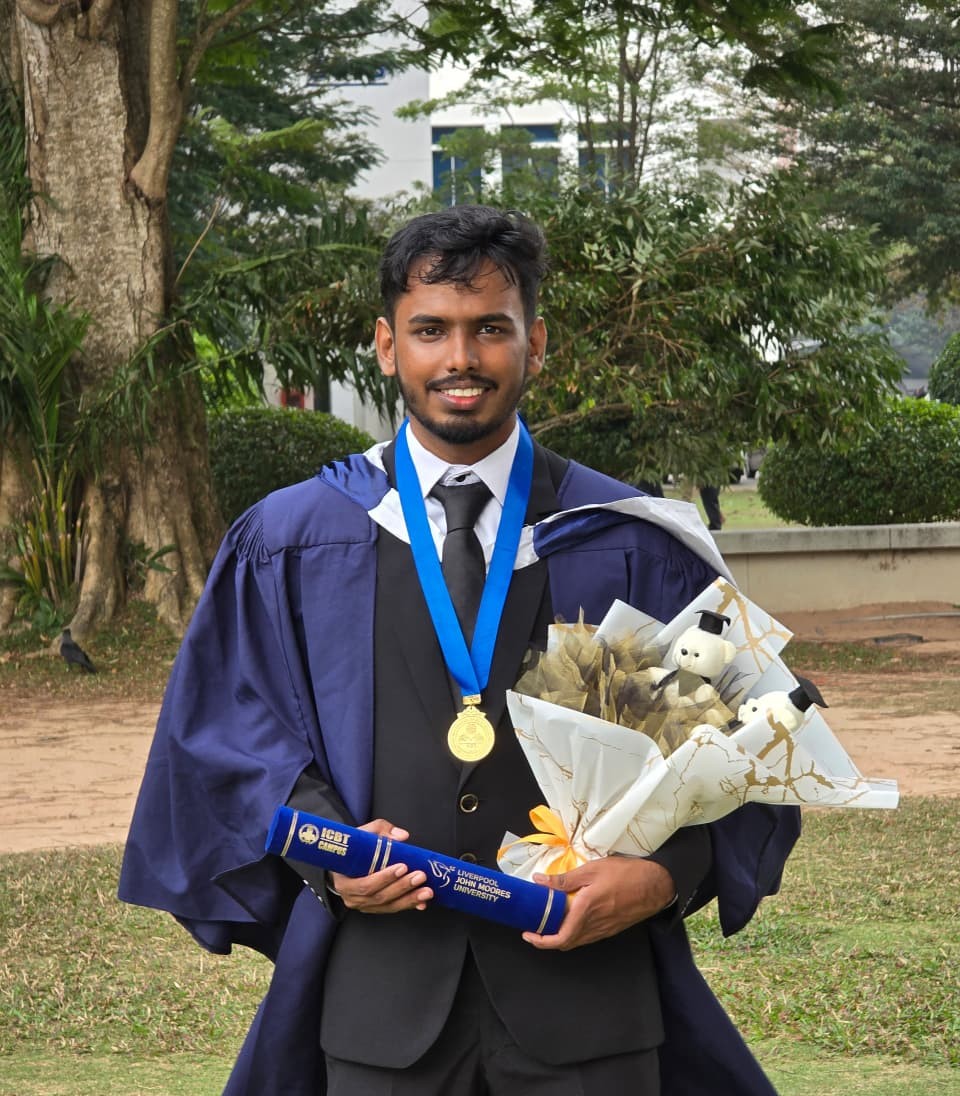
Rathnayaka
Higher Diploma graduate in Electrical & Electronic Engineering with interests in RTL-level digital design, processor architecture, semiconductor systems, and applied AI. Currently pursuing a BEng (Hons) at the University of Sunderland and developing simulation-based digital design projects, including a custom 8-bit CPU and adaptive cache controller.
Electrical & Electronic Engineering
Liverpool John Moores UniversityElectrical & Electronic Engineering
Custom 8-bit CPU · Adaptive Cache Controller
Hayleys Fabric PLC · Engineering Department
My interest in engineering comes from a curiosity about what happens inside electronic and computing systems. I have always been more interested in understanding how circuits, controllers, processors, sensors, and software work together than simply using the finished technology. Studying Electrical and Electronic Engineering gave me a structured foundation in these areas and gradually developed my interest in digital systems, embedded hardware, processor design, and intelligent computing.
During my six-month in-plant training with the Engineering Department at Hayleys Fabric PLC, I gained practical exposure to industrial electrical systems, automation, maintenance, and manufacturing operations. I assisted with machine installation and commissioning, electrical wiring and sensor connections, basic VFD configuration, motor-control systems, pneumatic equipment, preventive maintenance, and technical data analysis. I also contributed to activities involving a sensor-controlled rainwater-harvesting concept, production-machine performance analysis, energy monitoring, and maintenance reporting. This experience helped me understand how engineering decisions are applied in a real industrial environment, where safety, reliability, efficiency, and clear technical communication are essential.
My current interests are focused on RTL-level digital design, processor architecture, semiconductor systems, embedded intelligence, and applied AI. I am developing simulation-based projects such as a custom 8-bit CPU and an adaptive cache-controller concept to improve my understanding of datapaths, control logic, memory behaviour, and verification. I am particularly curious about how AI techniques, including reinforcement learning, could eventually be applied to hardware and memory systems—for example, to explore adaptive cache-management strategies. My goal is to continue building practical knowledge while contributing to opportunities across electronics, digital systems, embedded technology, industrial engineering, and related technical roles.
Electrical & Electronic Engineering
University of Sunderland
January 2026 — Present
Electrical & Electronic Engineering
Liverpool John Moores University
ICBT Campus
October 2023 — August 2025
Academic Excellence Award
Natural Sciences
The Open University of Sri Lanka
April 2024 — Present
Applied Mathematics · Physics · Computer Science
These academic projects gave me direct exposure to digital design, embedded systems, electronics, control, robotics, and engineering analysis through physical builds, laboratory work, and simulation.
BEng Final Year Project · University of Sunderland
An in-progress simulation-based digital design project exploring an adaptive cache controller for a custom 8-bit processor. The work focuses on CPU architecture, memory behaviour, RTL modelling, verification, and the possible use of reinforcement learning for adaptive cache-management decisions.
CPU datapath, control logic, instruction execution, and cache behaviour.
Simulation-based RTL and processor-design project.
Adaptive cache management and reinforcement-learning-based policy selection.
Higher Diploma Final Year Project · Group Project
A completed group project investigating autonomous robot navigation using SLAM, environmental sensing, object recognition, and reinforcement-learning concepts. The system was evaluated primarily through simulation, with emphasis on localisation, navigation behaviour, and layered safety mechanisms.
Autonomous navigation, obstacle awareness, localisation, and route behaviour.
SLAM-based navigation supported by semantic perception and reinforcement-learning concepts.
Group Final Year Project evaluated primarily through simulation.
This section includes embedded prototypes that were physically assembled and circuit projects that were built, measured, and tested in the laboratory.
Embedded robotics prototype
Built an Arduino-based autonomous guided vehicle that used sensors to detect obstacles, follow a guided route, and stop at designated points. The prototype demonstrated embedded control, sensor-based decision making, and coordinated motor movement.
Sensor-based irrigation control prototype
Built a PIC-based soil-moisture monitoring and irrigation system. The circuit read the sensor signal through the microcontroller's ADC, compared the measured value with a moisture threshold, and activated the watering output when the soil was too dry.
Practical transient-response investigation
Constructed and tested RC, RL, and RLC circuits to study first- and second-order behaviour. Measured their transient and steady-state responses with laboratory instruments and compared the practical results with calculations and simulation.
AC-to-DC conversion and filtering
Constructed and tested a full-wave rectifier circuit to convert an AC input into a DC output. Observed the rectified waveform, measured ripple, and evaluated how a smoothing capacitor improved the output using standard laboratory equipment.
BJT biasing and small-signal gain
Constructed and biased a BJT common-emitter amplifier, applied a small input signal, and measured the amplified output. The experiment examined voltage gain, operating-point stability, and the behaviour of a practical analogue amplifier stage.
Logic-gate IC water-level and pump controller
Physically built a water-level controller using logic-gate ICs and level-sensing inputs. The hardware logic determined the tank condition and controlled the pump output automatically without using a microcontroller or software.
These projects were developed and evaluated using HDL, MATLAB/Simulink, Python, and PLC simulation tools.
Ten-patient alert prioritisation and display logic
Designed and simulated a ten-input hospital patient alert system in Verilog. When several patients request assistance simultaneously, priority logic selects the highest-risk request, giving precedence to critical patients such as those in intensive care. The selected patient or ward information is displayed through seven-segment outputs.
Engineering data interpretation
Used Python to examine a multivariable electrical dataset, identify relationships between parameters, and evaluate engineering trends. The analysis applied correlation, regression, and hypothesis testing to turn the measured data into interpretable results.
Nonlinear control-system modelling
Created a MATLAB/Simulink model of the ball-on-beam system and applied PID control to keep the ball near a reference position. The simulation was used to evaluate stability, overshoot, settling behaviour, and steady-state error.
Biomedical signal processing
Processed ECG recordings from an apnea dataset using MATLAB. Applied digital filtering to reduce noise and used FFT-based analysis to examine frequency components and extract useful signal information for interpretation.
Industrial sequence-control simulation
Developed and simulated a PLC ladder-logic sequence for an automated metal-shaping process. The program coordinated the operating steps and actuator actions in the correct order to represent an industrial control cycle.
Hayleys Fabric PLC · Engineering Department · Neboda, Sri Lanka
Completed six months of in-plant training with the Engineering Department at Hayleys Fabric PLC, gaining practical exposure to industrial automation, machine installation and commissioning, electrical maintenance, instrumentation, pneumatic systems, engineering data analysis, and manufacturing operations.
View Training ConfirmationCollected production data and performed Excel-based analysis using the Pleva dwell-time module.
Participated in the conceptual development of a rainwater-harvesting system for the water-treatment plant, including understanding sensor-based control logic integrated with PLC systems.
Began formal study in Electrical and Electronic Engineering, developing foundations in circuit analysis, analogue electronics, electrical measurements, and digital logic through coursework and laboratory work.
Progressed from circuit-level work into embedded, control, and analysis projects using PIC, Arduino, MATLAB/Simulink, and PLC tools.
Completed a group Final Year Project in SLAM-based autonomous navigation and six months of in-plant training with the Engineering Department at Hayleys Fabric PLC, connecting academic robotics with industrial automation, maintenance, and instrumentation.
Graduated with Distinction and received the Academic Excellence Award.
Currently pursuing a BEng (Hons) and developing a simulation-based custom 8-bit processor with an adaptive cache-controller concept, focusing on RTL design, processor architecture, memory behaviour, and verification.
My long-term direction is toward digital hardware, embedded systems, processor architecture, and intelligent computing. I am open to unfamiliar engineering problems and willing to adapt, learn quickly, and contribute wherever my technical skills can create value.
TECHNICAL KNOWLEDGE
Languages, development tools, engineering platforms, hardware systems, and technical methods used across academic projects, laboratory work, current study, and industrial training.
01
Languages used for digital design, embedded control, robotics, analysis, and automation.
02
Simulation, design-entry, modelling, analysis, and development environments.
03
Robot simulation, navigation, perception, and learning-based system concepts.
04
Physical prototypes, laboratory hardware, industrial control, instrumentation, and maintenance exposure.
05
Core methods used to model, simulate, inspect, and develop digital systems.
06
Measurement, modelling, data analysis, reliability reporting, and engineering support methods.
WORKING APPROACH
Breaks technical problems into smaller functional parts and evaluates practical solutions through analysis, simulation, testing, or observation.
Learns unfamiliar tools and systems through documentation, guided practice, simulation, experimentation, and feedback.
Uses measurements, system behaviour, engineering data, and cause-and-effect reasoning to support technical decisions.
Contributed to group engineering projects and worked alongside engineering and maintenance teams during industrial training.
Records observations, prepares reports, interprets technical information, and communicates engineering issues clearly.
Comfortable learning across electronics, automation, embedded systems, digital design, maintenance, and related technical work.
Experienced in data collection, maintenance reporting, BOQ assistance, technical-issue recording, and structured academic documentation.
Understands the importance of safe procedures, equipment reliability, preventive maintenance, and careful verification in engineering work.
I am seeking graduate, trainee, junior engineering, and related technical opportunities where I can contribute, continue learning, and build practical industry experience. My strongest interests are in electronics, digital systems, embedded technology, industrial automation, and hardware-oriented engineering, while I remain open to broader technical roles that value problem-solving, adaptability, and a willingness to learn.
Roles connected to electronic and hardware-oriented system development.
Practical work involving industrial electrical and automated systems.
Opportunities that provide responsibility, technical growth, and useful industry exposure.
I am comfortable facing unfamiliar technical problems and learning the tools, systems, or processes required to solve them. I value practical observation, structured analysis, testing, documentation, and collaboration with experienced engineering teams.
Currently available across five weekdays for employment, internships, contract work, remote work, or technical projects.
I am open to discussing graduate, trainee, junior engineering, contract, remote, and related technical opportunities. Please contact me by email or LinkedIn for roles, projects, or professional collaboration.